

Shipping an IoT product is not shipping a connected gadget
Getting one device to blink over Wi-Fi is a weekend. Turning that into a product real people can buy, onboard, and rely on is a different thing entirely. Do it the traditional way and you’re on the hook for all of this:Connectivity
Wi-Fi provisioning, a realtime server, reconnection, OTA updates.
A user interface
A dashboard framework, live data binding, controls, theming.
Data & accounts
A database, user accounts, device-to-user onboarding, permissions.
An app & a business
A branded mobile app, a way to distribute, and a way to get paid.
Hyperwisor is that entire stack, done once
Hyperwisor is an end-to-end platform for building, shipping, and selling IoT products. You write the part only you can write — what your device senses and does — and the platform handles the rest: connectivity, dashboards, onboarding, apps, distribution, and payments.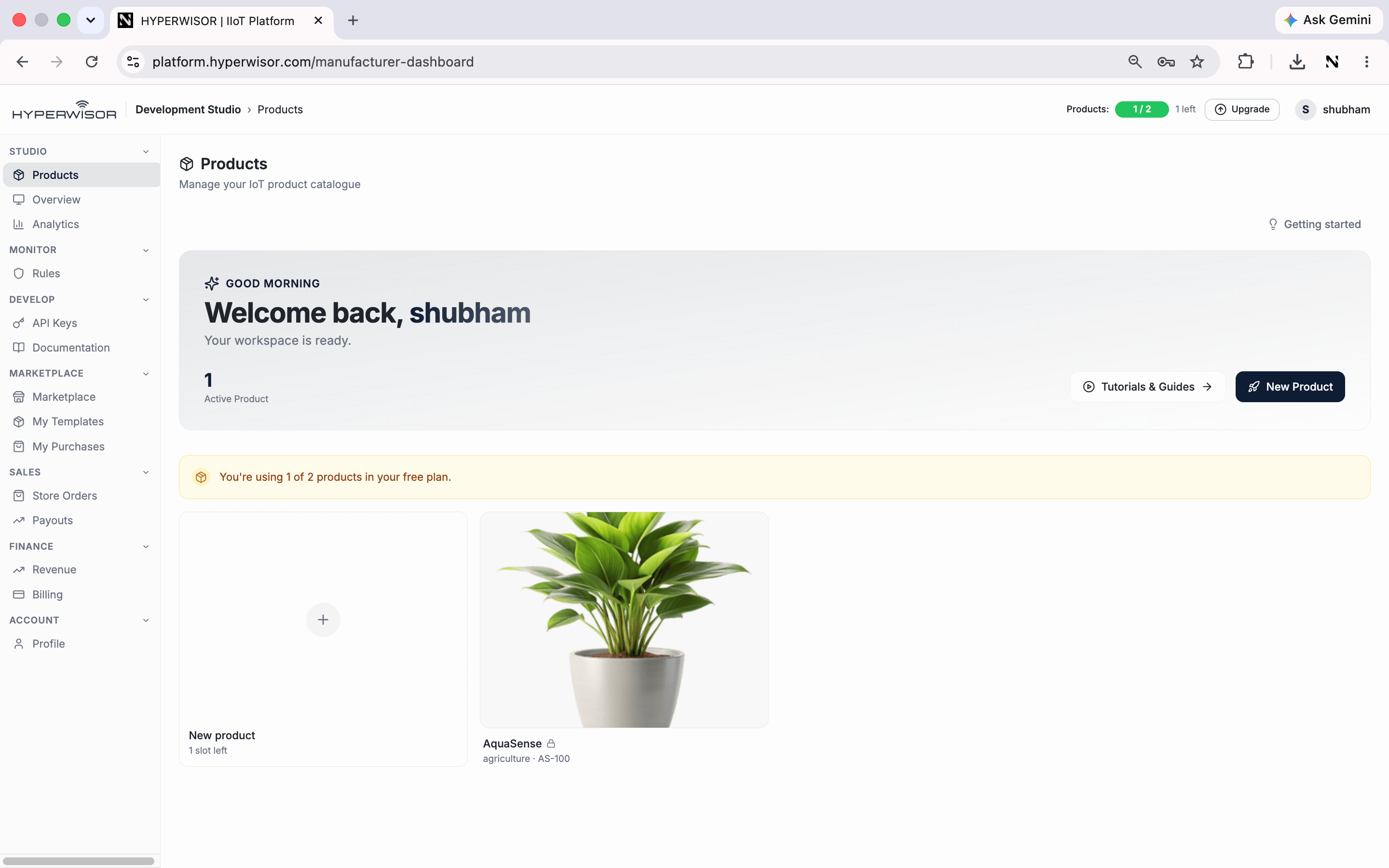
The manufacturer Studio — every product you build, from idea to a device buyers can onboard.
The mental model: you build the product once; the platform carries it to
users. Think in terms of capabilities — “my device reports moisture and can
run a pump” — not plumbing. Everything in these docs maps a capability to a tool.
Why here, instead of the alternatives
Most options make you choose between control and speed. Hyperwisor is built so you don’t have to.
The difference that matters: Hyperwisor doesn’t stop at “your device is online.”
It takes you to “your product is for sale and earning.” The marketplace,
white-label app, and built-in payments make it a business platform, not just a
dev tool — the infrastructure layer that lets one design reach thousands of
devices.
Three roles, one platform
Manufacturer
Builds a product: defines commands, designs a dashboard, flashes firmware
with the Hyperwisor SDK, and publishes to the marketplace.
User
Onboards a device by scanning its QR code, then monitors and controls it
from the manufacturer’s dashboard.
Integrator
Builds custom multi-device dashboards with 50+ drag-and-drop widgets, or a
bespoke branded app with the app-starter.
What you build with
Firmware SDK
Arduino and ESP-IDF libraries for ESP32-class devices today — more boards on
the way, and any board that speaks WebSocket, MQTT, or HTTPS can connect.
Wi-Fi provisioning, realtime, OTA, and widget updates behind simple calls.
Dashboard Designer
A no-code canvas with 50+ widgets. Bind one to device data and it updates
live; add a control and it sends a command back.
Product Studio
The manufacturer workspace — database, users, rules, testing, voice
assistants, and more, per product.
White-label Apps
A branded web + mobile app for your device line, with AI-generated screens.
Where to start
How it works
The one idea that ties firmware and dashboards together.
Create a product
The 4-step wizard — and how to think about each choice.
Lessons
A guided path from first device to published product.
Firmware SDK
Pick Arduino or ESP-IDF and flash your first device.